English Writing
Nurturing Confident, Creative Young Writers
Our Writing Curriculum
At St Joseph’s, our approach to writing is designed to develop confidence, creativity and strong literacy skills in a supportive and engaging environment. We follow a carefully structured weekly routine that ensures children experience and practise the full writing process, grounded in rich reading experiences and a variety of genres. Our writing lessons are always linked to a high-quality reading book, which changes every half term, and is also the focus of ‘Master Readers’ reading lessons. This shared text provides a rich context and inspires our ideas and vocabulary choices in writing lessons.
Our Weekly Writing Routine
Monday: Exploring Genre Features
Each Monday, we dive into the features of the genre we are focusing on for the week. Whether it’s a fairy tale, a letter, a newspaper report or a poem, we look at real examples, discuss their unique characteristics and talk about what makes them effective. This helps our writers to understand the purpose and structure of different types of writing.
Tuesday: Grammar and Punctuation Focus
On Tuesdays, we zoom in on a particular grammar or punctuation skill linked to our genre. This might involve practising speech marks for dialogue, creating effective noun phrases, or mastering how to use commas in a list. By focusing on one skill at a time, our pupils build a strong toolkit for their own writing which they continue to apply as the year goes on.
Wednesday: Planning Our Writing
Wednesdays are all about planning. Children use a range of framing devices to organise their ideas. We encourage talking through plans with friends, sharing ideas as a class, and making writerly decisions to inform the major writing sessions on Thursday and Friday. Planning helps children feel prepared, ready and excited to write.
Thursday & Friday: Writing Time
The end of the week is dedicated to writing. On Thursdays and Fridays, children create their own pieces based on the genre and skills we’ve explored. There is time for drafting, editing, and sharing work with classmates. We celebrate all efforts and encourage pupils to be proud of their progress.
Why This Approach Works
- Children experience a range of genres and writing purposes.
- Skills are taught in manageable steps, building over the year, with multiple opportunities to apply learnt skills in writing.
- Planning and discussion build confidence before writing.
- Reading is at the heart of our writing, providing real examples and inspiration.
- Writing is a regular activity, giving our writers bountiful opportunity to practise transcription and apply learnt skills.
- Every child is supported to become an independent, enthusiastic writer.
Non-negotiables
We follow the National Curriculum to teach age-related grammar, punctuation and transcription skills in each year group. We encourage a list of ‘Non-negotiables’ in each year group to guide our writers in applying these elements to their writing.
Non negotiables
Spellings
After Phonics, we learn to spell words by studying spelling patterns and encourage our writers to apply these to their writing. We teach spelling using ‘Read Write Inc. Spelling’, a 15‑minute‑a‑day, systematic, cumulative spelling programme for Years 2–6. It builds directly on Read Write Inc. Phonics and teaches children to apply spelling rules confidently through fast‑paced, consistent routines.
Core principles:
- Daily, snappy lessons that fit easily into the timetable.
- Direct teaching followed by partner practice, so children actively rehearse new concepts.
- Cumulative progression: each unit builds on previously taught patterns and rules.
Dictionary skills are also taught to gradually become independent in checking the spelling of words. We also encourage all children to learn the Age-related spellings set out in the National Curriculum:
Year 1 Common Exception Words
Year 2 Common Exception Words
Year 3 and 4 Spelling Word List
Year 5 and 6 Spelling Word List
Writing Progression Sentence Structures
As well as grammar and punctuation foci, our Tuesday skills lessons frequently explore sentence structures which develop through the key stages:
Progression Sentence Structures
Handwriting
Handwriting is taught using Read Write Inc’s handwriting programme called Letter Village. Handwriting is taught from Reception to Y5 explicitly and regularly, meaning separately from main Writing lessons. Letter Village has 10-minute videos which are taught 3 times a week in the following stages:
- Reception – Stage 1
- Y1 – Stage 2 (Letter Village videos start)
- Y2 – Stage 3
- Y3 and 4 – Stage 3 and 4
- Y5 – Stage 3 and 4
- Y6 – Intervention for handwriting fluency (use Stage 3+)
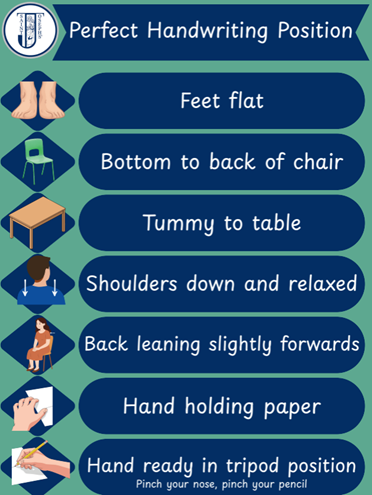
At St Joseph's we promote correct writing posture to support our writers to write neatly and legibly: